The Callout That Kept Me Busy: Dirty Water
This post contains an Amazon affiliate link. As an Amazon Associate, I earn from qualifying purchases.
When I first started in the central heating business, boilers, radiators, and pipework were all made from heavy-duty materials. The boiler was a great big lump of cast iron. The radiators were heavy because the steel used to make them was thick. Even the copper pipe connecting everything was twice the thickness of today’s pipe.
Why does that matter? I’ll explain — but first, a quick question.
When you vent a radiator, is the water that comes out black? Simple yes or no.
- If no — your system’s water is protected. An inhibitor has been added.
- If yes — your central heating system is corroding away internally, right now. You won’t see it from the outside; your radiators can look perfectly shiny while they’re rotting away inside.
Do you have a radiator you always seem to need venting? An unprotected system produces hydrogen gas, and that’s what comes out first, before the black water follows.
What’s actually happening
Your central heating system is built from several different metals — iron, steel, copper, brass, and more. The moment you add water to the system, these metals start chemically reacting against each other. Within roughly 3-4 months, you’ll see the water inside the system beginning to turn black.
There’s a simple way to prevent this: the water needs to be dosed with an inhibitor. That’s genuinely all it takes.
Why this matters more today than it used to
Going back to the start of this article — the boilers and radiators of the past were made from very thick materials. Central heating systems back then had exactly this same corrosion problem, but you barely noticed it, simply because the metals were so thick, there was more material to eat through before it caused a failure.
Today’s boilers and radiators are completely different. We’ve gone from a great big lump of cast iron to lightweight, high-efficiency wall-mounted boilers. Water flows through very narrow waterways inside these boilers — it’s part of the design that makes them efficient. Radiators are the same; today’s convector radiators have much narrower waterways than the old panel radiators did.
An untreated system will soon start showing problems: cold spots on radiators, a boiler making a noise like a kettle boiling. These are all early warning signs that repairs are coming.
A Friday afternoon I remember well
My last job of the day was a boiler service for a new customer. I finished the service, wrote the invoice, took payment, and was seen to the door. As I walked to my van, the customer called me back: “Quick, quick — I’ve got water coming from my radiator!”
A pinhole had appeared in the radiator. Luckily, the valves could be shut off easily to stop it. Sometimes these pinholes are triggered by a shift in air pressure — in this case, likely the customer closing the front door behind me caused just enough pressure movement for the pinhole to open up.
I stopped the leak and explained what had happened. At first, he assumed it was something I’d done during the service, and tried to say the boiler service was the cause.
I used to carry a water test kit in my van — given to me years earlier by an inhibitor manufacturer. I brought it in and showed him the difference: two small sample jars, each with a piece of metal inside, one treated, one untreated. The untreated sample was black and oily; the treated one was completely clear.
He could then see for himself that the water leaking from his radiator was every bit as black as that sample — black enough that it had marked his pure white carpet like someone had poured oil over it.
He accepted it wasn’t my doing, and asked what could be done. Replacing the one radiator wasn’t the real concern — the bigger question was how many of his other radiators were in the same state.
We talked it through, and he decided to replace most of his radiators. I also recommended having the whole system flushed with a cleaning agent, then dosed with an inhibitor afterwards to stop the problem recurring. He agreed, and the work was carried out at a later date.
A cleanout can reveal more than it fixes
When a central heating system is properly cleaned out, it sometimes reveals other leaks — because the process removes the black sludge that had been eating away at the metal, sometimes concealing damage that was already there. This is very common in a system that’s never been treated.
The long-term cost of doing nothing
An unprotected system will eventually cause blocked radiators, damaged boiler heat exchangers, worn pumps, and more. In my experience, a boiler’s life expectancy on an unprotected system was around 5 to 8 years. On a properly protected system, there’s no real reason it can’t run indefinitely.
Two tips that get missed constantly
- At your annual boiler service, ask your engineer to check whether the inhibitor needs topping up — it gradually loses its effectiveness over time. Yearly is the recommended interval, though I found every two years was generally fine in practice.
- If you ever remove a radiator for decorating, top up the inhibitor when you refit it. This gets missed far more often than you’d expect. I’ve had customers insist it’s unnecessary because the system “already has inhibitor in it” — what they don’t realise is that refilling with fresh water dilutes the existing inhibitor and weakens its protection.
Nowadays, most central heating systems are fitted with a water filter that traps debris before it can cause damage — I’ll cover that properly in a separate article.
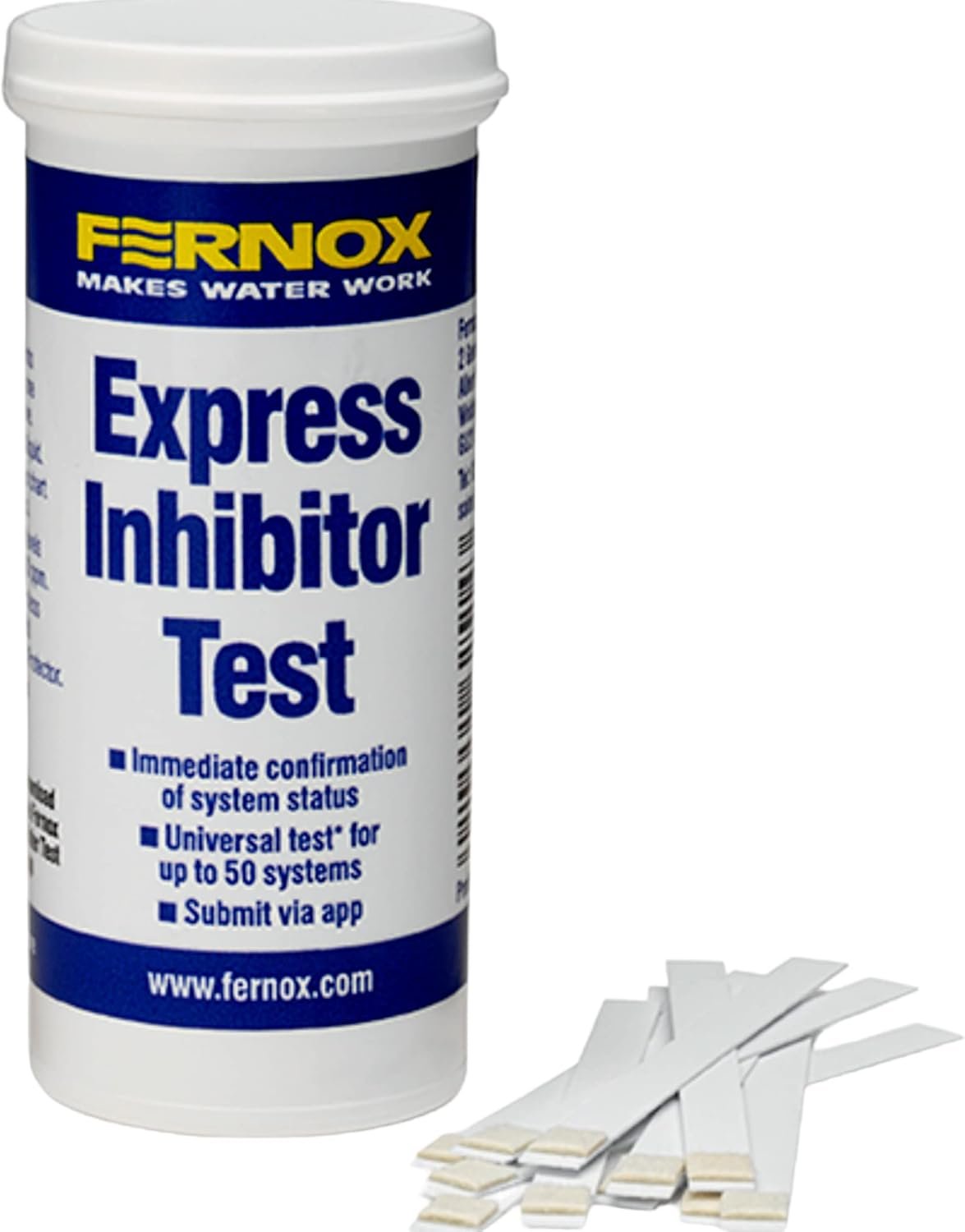
If you want to check your own system