Keeping Your Boiler Happy
This post contains an Amazon affiliate link. As an Amazon Associate I earn from qualifying purchases.
Over the years, many central heating boilers have suffered blockages in their heat exchangers due to dirty water in the system — something that could easily have been prevented with an inhibitor added at the right time.
As boilers became more efficient and smaller, manufacturers began stating in their installation instructions that the system must be flushed out and dosed with an inhibitor. This eventually became tied to the boiler’s warranty too — if an engineer attended a breakdown and tested the water only to find no inhibitor present, the warranty could be voided on the spot.
The rise of the magnetic filter
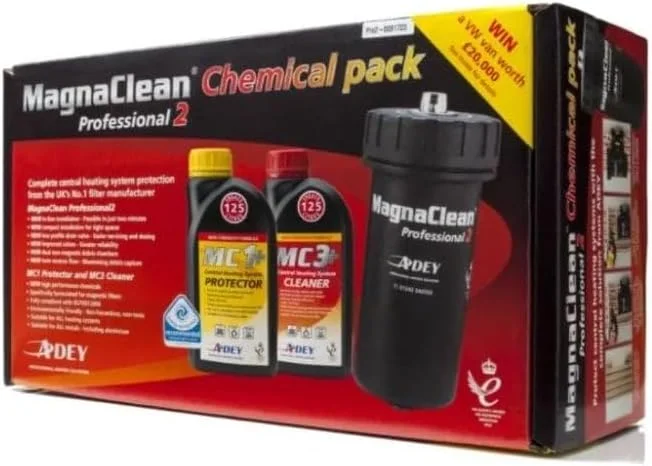
Eventually, manufacturers began requiring, as part of their warranty terms, that every boiler be fitted with a magnetic filter on the pipework, as close to the boiler as possible — normally on the return pipe, to stop debris reaching the heat exchanger and causing damage.
It also had to be genuinely accessible for maintenance. I’ve come across filters fitted in such awkward, hard-to-reach spots that I refused to service them until they’d been moved somewhere sensible.
The Benchmark Book
Every boiler on the market comes with a Benchmark Book — a legal document that the installer must complete, sign, and date. This includes sections confirming whether the system was flushed, whether an inline filter was fitted (and its make), and which brand of inhibitor was used. Missing this paperwork gave manufacturers a genuine get-out clause on the warranty.
Some manufacturers went further, producing their own branded filters and offering extended warranties if installed alongside their new boilers.
For a period — I believe around 2018 (Boiler Plus) — fitting an inline filter was considered best practice rather than a legal requirement, and most installers followed it regardless. It later became a firmer, more formally enforced requirement, tied to updated Part L building regulations, which require the filter to capture both magnetic and non-magnetic debris.
What boiler manufacturer training taught me
Over my working years, I attended plenty of boiler manufacturer training courses — a good way to stay current with new models, and to hear directly from manufacturers about which models had recurring problems. Boiler breakdowns came up constantly in these sessions, and the majority of the time, the actual cause wasn’t the boiler itself — it was the condition of the water inside the system.
Because of this, manufacturers started stating clearly: if they attended a warranty callout and found dirty water was the cause, they’d charge for the visit. I always thought that was entirely fair.
A common combi boiler problem: pressure switches
A very common issue with combination boilers involved the water pressure switch — a component with a tiny hole that senses pressure. These holes tend to block up over time, stopping the boiler from working. The fix is to remove the switch and clean it out, or, as I always preferred, replace it outright.
Another common one: the hot water plate exchanger
This was another frequent culprit. Some engineers would remove it and chemically clean it in place. I always chose replacement instead — you can’t see inside a plate exchanger, so you can never be fully certain you’ve cleared every blockage. Replacing it also avoided callbacks.
The warranty misunderstanding I saw constantly
When I explained to a customer why their boiler had stopped working, the most common response was: “But my system had an inhibitor added when the boiler was installed.” When I’d ask whether it had been checked since, the answer was often no — because they had a 5-year warranty, so they assumed it was covered regardless.
I’d usually respond the same way every time: “Have you actually read the warranty conditions?” Almost always, no. Then I’d draw the comparison to a car: “Your car’s got a 3-year warranty — are there conditions on it?” “Yes, it needs an annual service.” “How do you know that?” “The dealer told me.” “So why would a boiler be any different?”
For some reason, people consistently assumed a long warranty meant they didn’t need to do anything at all — when in reality, the opposite was true.
Where things stand today
Current Part L regulations require an inline filter on every system, one that must be cleaned and flushed with a quality inhibitor, and fully replenished every 5 years.
So — how do you keep your boiler happy?


